By Leslie Rae Ferat, Mercedes Carballo, Daniel Dorado, Gianella Severini, Erin Roman, Ahmad Abbadi, Domilyn C. Villarreiz and Ouleymatou Diop
Global Alliance for Tobacco Control (GATC)
Introduction
Decades of tobacco control policies and global awareness efforts have contributed to declining smoking rates. In response, the tobacco industry has shifted towards alternative nicotine products, including e-cigarettes, heated tobacco products, and nicotine pouches, prioritising market survival over public health. While the products have evolved, the industry’s strategy remains the same: sustaining nicotine addiction, expanding consumer bases, and adapting to stronger tobacco control measures under the guise of “innovation”.
The marketing strategy behind these non-medicinal nicotine products has allowed the tobacco industry to deceptively position itself as part of the solution, through a self-defined version of “harm reduction”. While the industry portrays itself as an ally in ending the tobacco epidemic, global sales data reveal a different reality: alternative products are not replacing conventional cigarettes; they are complementing them, capturing entirely new market segments to fuel a dual-use lifestyle and trap a new generation.
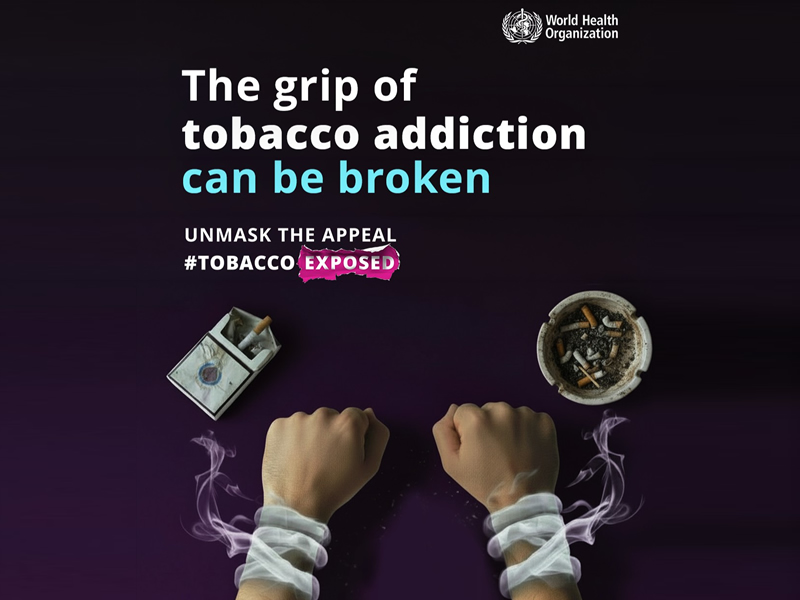
This years World Health Organization (WHO) World No Tobacco Day theme seeks to unmask the appeal, to counter nicotine and tobacco addiction. The WHO Framework Convention on Tobacco Control (FCTC), the first public health treaty in history, provides evidence-based measures, guidelines to support implementation and the decisions adopted by the Conference of the Parties (COP)to advance comprehensive tobacco control policies and protect public health measures from tobacco industry interference, as established under Article 5.3 of the Convention. Taken together, these measures constitute the most effective and evidence-based pathway to reduce tobacco use, prevent nicotine addiction, and ultimately end the tobacco epidemic.
II. Unmasking the “Harm Reduction” Narrative
For years, the tobacco control community has sounded the alarm about the threat posed by non-medicinal nicotine products to public health. The WHO and the COP to the WHO FCTC have emphasized the risks that these products bring and showcased the attempts from the tobacco industry to interfere with the evidence and science that supports their “harm reduction” narratives. Article 5.2(b) of the WHO FCTC places legal obligations on Parties to adopt and implement measures to prevent and reduce tobacco consumption, nicotine addiction, and exposure to tobacco smoke, in accordance with their national capabilities.1 Article 5.3 requires Parties to protect their public health policies with respect to tobacco control from the commercial and other vested interests of the tobacco industry in accordance with national law. Measures regulating nicotine products, including prohibiting or restricting their commercialization are consistent with Parties’ general obligations under the WHO FCTC and its implementation guidelines.
The UN Special Rapporteur on the right of everyone to the enjoyment of the highest attainable standard of physical and mental health recognized the tobacco industry’s strategies stating that “[t]he skepticism towards the tobacco industry’s harm reduction initiatives stems from their long and well-documented history of duplicitous behavior, concealing and downplaying the health risks of their products, while deceptively marketing alternatives as harm reduction or quitting alternatives as ascertained in judicial proceedings.”2 The Special Rapporteur further observed that corporations like tobacco companies seek “to position themselves as part of the solution to problems that they have largely created.”3
These concerns were recently reaffirmed in the Dublin Declaration adopted at the World Conference on Tobacco Control 2025, which recognized “the tobacco industry as the biggest barrier to global progress in tobacco control”.4 This reflects growing international consensus reflects increasing concern regarding the industry’s continued efforts to rebrand itself through non-medicinal nicotine products, nicotine analogues, and tobacco products while undermining effective public health regulation.
Harm reduction should be understood as the full implementation of the WHO FCTC’s evidence-based measures, treaty instruments, and COP decisions aimed at reducing and ultimately eliminating the harms of tobacco use and nicotine addiction. The tobacco industry’s use of “harm reduction” narratives to make unproven health claims about non-medicinal nicotine products and tobacco products is intended to promote commercialization and weaken regulation, constituting a form of policy interference inconsistent with Article 5.3 and its Guidelines for implementation. Any consideration of nicotine products should be based on independent evidence, subject to strong regulation, and overseen by public health authorities rather than industry interests.
III. Protecting the Next Generation
Youth uptake of e-cigarettes and other non-medicinal nicotine products is increasing at alarming rates in many countries around the world. Data from the Global Youth Tobacco Survey show that, across WHO regions, current e-cigarette use among 12–16-year-olds ranges from 3.3% in Southeast Asia to 10.8% in the Western Pacific, with reported rates of 7.8% in the Americas, 9.3% in Europe, 9.9% in Africa, and 10.6% in the Eastern Mediterranean.5 Evidence shows that the tobacco industry has been aggressively marketing non-medicinal products to youth, women and vulnerable populations.6/7 Statistically, the likelihood of adults starting to smoke in their mid-20s is very low. Nearly 90% of tobacco and non-medicinal nicotine products users start before the age of 18. This isn’t a choice – it’s a strategy.8
 These products also create opportunities for public health policy interference and complicate progress in global and national tobacco control efforts. While prevalence and regulatory landscapes differ from country to country, there is wide-spread concern regarding the use of nicotine products by young people and non-tobacco users, and the protection of these groups from the health impacts of these products, particularly as research on the long-term use is evolving.
It is critical to distinguish between regulated nicotine replacement therapies (NRTs), which are scientifically validated and approved by medical authorities as cessation aids, and delivered within a therapeutical framework and the commercial wave of non-medicinal nicotine. Non-medicinal nicotine products include products containing naturally or synthetically derived nicotine, as well as devices designed to imitate or substitute nicotine use, which are often marketed outside therapeutic frameworks and promoted in ways that appeal to young people and non-users. Unlike medically regulated cessation products, these commercial products are increasingly being used to sustain nicotine dependence and expand the market for addiction. The industry uses the lack of regulation on synthetic nicotine/analogues to explicitly bypass therapeutic standards.
The WHO released this month a report titled Exposing marketing tactics and strategies driving the growth of nicotine pouches. This report warns about the aggressive marketing of nicotine pouches to adolescents and young people further reinforce these concerns. The rapid expansion of flavored, discreet, and highly engineered nicotine products demonstrates how the industry continues adapting its strategies to attract new generations of users while framing these products as part of a so-called “harm reduction” approach.
Rather than contributing to the end of the tobacco epidemic, these commercial practices risk normalizing nicotine addiction among youth and undermining decades of progress in tobacco control.9
These concerns have also been echoed by youth advocates globally. In the lead-up to COP11, youth organizations from different regions issued an open letter10 urging Parties to protect present and future generations from the tobacco and nicotine industry’s targeting strategies. They warned against the growing normalization of nicotine addiction among youth through non-medicinal nicotine products. The declaration highlighted the urgent need for stronger implementation of the WHO FCTC and greater protection of public health policymaking from industry interference.
The industry’s “harm reduction” narrative isn’t just an abstract corporate strategy; youth addiction is the direct consequence of it. This unfolding youth epidemic is precisely why the debates and negotiations at COP11 and the upcoming COP12 are so critical.
IV. What the COP11 Deferral Means
 The agenda for COP11 included a vital item called “Implementation of measures to prevent and reduce tobacco consumption, nicotine addiction and exposure to tobacco smoke, and the protection of such measures from commercial and other vested interests of the tobacco industry in light of the tobacco industry’s narrative on “harm reduction” (Articles 5.2(b) and 5.3 of the WHO FCTC)”. To support the discussion around this topic, the FCTC Secretariat prepared a COP11 report11 highlighting the coopting of the term “harm reduction” by the tobacco industry and the need for the public health community to reclaim it.
While this discussion under Agenda Item 4.5 was vital, it was not a debate on whether to regulate non-medicinal nicotine products, but a concrete effort by Parties to strengthen the implementation of Articles 5.2(b) and 5.3. The existing FCTC decisions already provide a clear mandate and since COP4(2010), WHO has provided evidence on emerging nicotine products and decisions adopted by COP7 and COP8 have already guided Parties to consider regulating or prohibiting ENDS/ENNDS as appropriate to their national laws and public health objectives. Furthermore, the WHO Study Group on Tobacco Product Regulation12 found that companies are aware that some tobacco control laws do not cover synthetic nicotine products and have sought to take advantage of such regulatory gaps and that even if synthetic nicotine products are restricted, companies may use analogues to replace nicotine in marketed products.
The challenge now lies in defending that COP mandate against an industry that has adjusted its entire strategy to frame itself as a public health partner. When the industry speaks of harm reduction, they are attempting to preserve the commercial viability of nicotine addiction. Therefore, the deferral of formal proposals under Agenda Item 4.5 at COP11 must not be misconstrued as a pause on these discussions. Iti is a critical window of vulnerability leading up to COP12. While a diplomatic decision on this agenda item may be on hold, the tobacco industry is not pausing its marketing.
This ongoing exploitation of legal loopholes demonstrates why Parties must use the intersessional period ahead of COP12 to strengthen implementation of Articles 5.2(b) and 5.3 of the WHO FCTC. Rather than a period of diplomatic pause, the lead-up to COP12 should be treated as a critical window to reinforce national implementation, strengthen regulatory preparedness, and build resilience against industry interference. This includes:
- Sharing national best practices in regulating non-medicinal products
- Actively addressing how the industry uses the ‘harm reduction’ to bypass the requirements of Article 5.2(b), which demands comprehensive multi-sectoral strategies to prevent and reduce nicotine addiction.
- Fully implementing Article 5.2(b) by adopting measures to prevent and reduce nicotine addiction through their regulation of non-medicinal nicotine products, recognizing that Parties’ approaches may vary as appropriate to their national laws and public health objectives.
- Rejecting the tobacco industry’s ‘harm reduction’ narrative that is being used to make unproven health claims about non-medicinal nicotine and tobacco products to further commercialization of its addictive products, to rebrand itself, and avoid or weaken the regulation of these products.
- Developing coordinated approaches ahead of COP12 that reaffirm public health-led definitions of harm reduction and strengthen protections against industry interference in nicotine regulation.
V. Conclusion: Reclaiming the Public Health Narrative
“Unmasking the appeal” is a direct call to see the modern nicotine pouch, synthetic analogue or flavored vape for what it really is; a highly engineered mechanism designed to hook the next generation of consumers. The tobacco industry is actively using these products to bypass traditional tobacco control measures and spark a new wave of global addiction. We must remember that the foundational objective of the WHO FCTC is to prevent and reduce tobacco use and nicotine addiction in all its forms. To protect future generations, governments must move beyond reacting to individual products and instead build comprehensive non-medicinal nicotine governance frameworks capable of resisting industry interference, future industry innovation attempts and prioritizing public health over commercial interests.
Unmasking the Appeal: Why the Industry’s “Harm Reduction” Narrative is a Smoke Screen for Youth Addiction1 WHO FCTC Article 5.2(b).
2 Report of the Special Rapporteur on the right of everyone to the enjoyment of the highest attainable standard of physical and mental health on harm reduction for sustainable peace and development. UN doc A/79/177. Paragraph 45. Published 18 July 2024. https://docs.un.org/en/A/79/177
3 Report of the Special Rapporteur on the right of everyone to the enjoyment of the highest attainable standard of physical and mental health on harm reduction for sustainable peace and development. UN doc A/79/177. Published 18 July 2024. https://docs.un.org/en/A/79/177
4 World Conference on Tobacco Control (2025), Dublin Declaration, accessible here https://worldtobaccocontrol.org/wctc-2025-declaration/
5 Greenhalgh, EM, Jenkins, S , EM, Bain and Scollo, MM. 18.3 Prevalence of e-cigarette use. In Greenhalgh, EM, Scollo, MM and Winstanley, MH [editors]. Tobacco in Australia: Facts and issues. Melbourne: Cancer Council Victoria; 2025. Available from https://www.tobaccoinaustralia.org.au/chapter-18-e-cigarettes/18-3-prevalence-of-e-cigarette-use
6 Report of the Special Rapporteur on the right of everyone to the enjoyment of the highest attainable standard of physical and mental health on harm reduction for sustainable peace and development. UN doc A/79/177. Published 18 July 2024. https://docs.un.org/en/A/79/177
7 Tobacco Tactics (2024) “Shaping Retail: Targeting Specific Communities” accessible here
8 WHO (2026), Exposing marketing tactics and strategies driving the growth of nicotine pouches
9 WHO (2026), Exposing marketing tactics and strategies driving the growth of nicotine pouches
10 Youth Letter to the Parties of the WHO FCTC at COP11, accessible here
11 WHO FCTC Secretariat (2025), FCTC/COP/11/10 Implementation of measures to prevent and reduce tobacco consumption, nicotine addiction and exposure to tobacco smoke, and the protection of such measures from commercial and other vested interests of the tobacco industry in light of the tobacco industry’s narrative on “harm reduction” (Articles 5.2(b) and 5.3 of the WHO FCTC) – proposed by Parties accessible here, accessible here
12 WHO study group on tobacco product regulation: report on the scientific basis of tobacco product regulation: tenth report of a WHO study group (2025), accessible here