
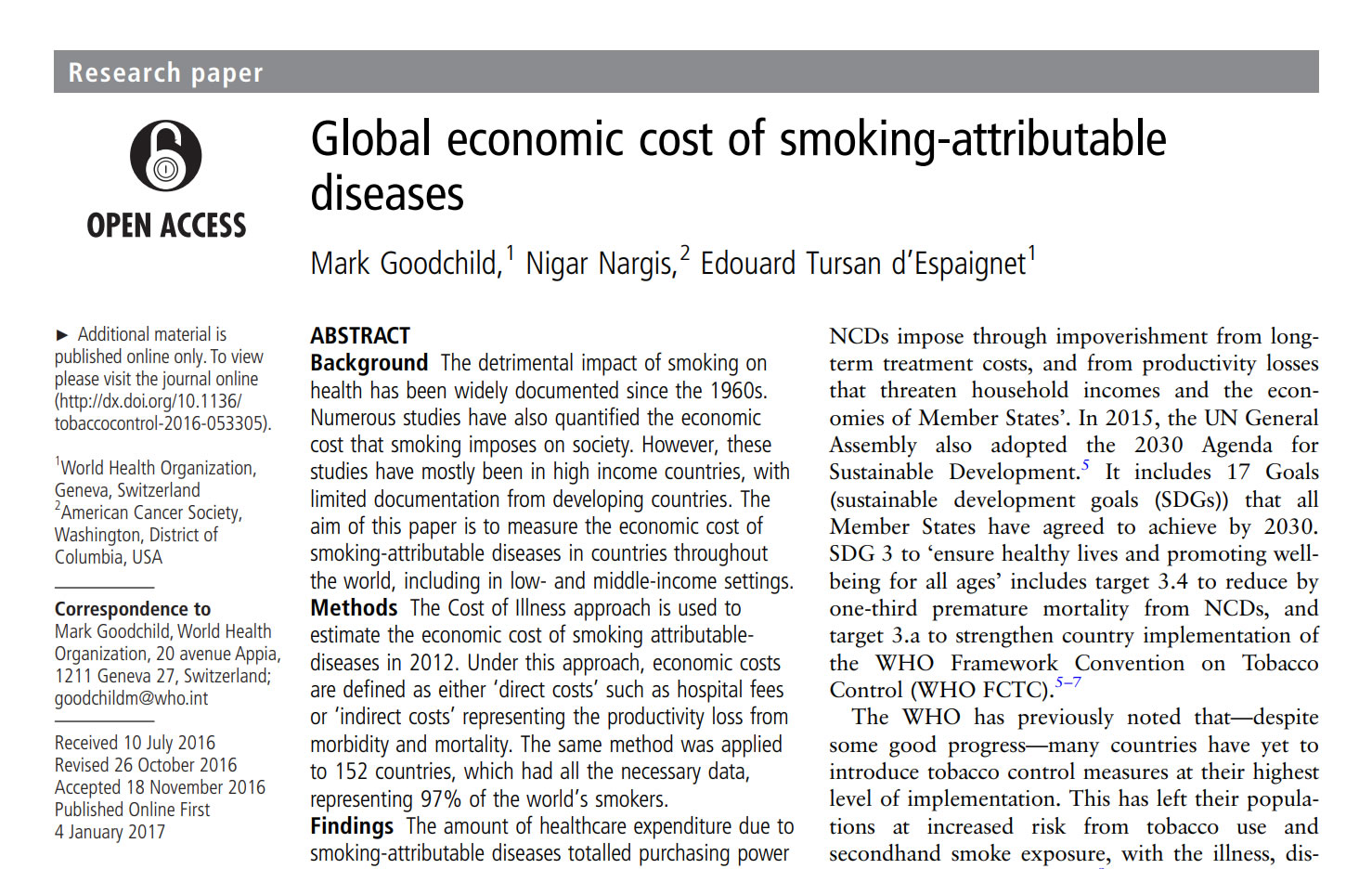
Key findings, arguments and recommendations: Smoking imposes significant economic costs globally. Effectively implementing tobaco control measures can reduce these costs while also help countries achieve the SDGs.
Key facts and stats: (1) Global healthcare expenditure due to tobacco-related diseases amounted to 422 million USD in 2012, making up 5.7% of global health expenditure; (2) The total economic cost of smoking (globally, 2012) was 1436 billion USD, which is equivalent to 1.8% of the world’s annual GDP; (3) Roughly 40% of the total economic cost was borne in developing countries.
Notes: Previous studies of the economic costs of smoking have predominantly looked at HICs, but this paper includes LMICs
Main focus: Economic costs
Other topics addressed:
Source: Article in Tobacco Control
Year: 2017
Document: Global economic cost of smoking- attributable diseases


OFFICE
Global Alliance For Tobacco Control
c/o HealthBridge
1 Nicholas St, Suite 1004
Ottawa, ON Canada K1N 7B7